
Power
How to Protect Your Electronics from an EMP: What Actually Works and What Doesn't

By Ephraim Rusk · · 10 min read
This article contains an affiliate link. If you buy through it, we may earn a commission at no extra cost to you.
Quick answer
To protect electronics from an EMP, store backup devices in a properly constructed Faraday cage — a grounded, conductive enclosure with no gaps — and keep critical items like a hand-crank radio, spare charge controller, and an unconnected power bank inside it. Consumer surge protectors offer zero protection against a true EMP.
How to protect your electronics from an EMP is one of the most searched — and most misunderstood — questions in prepper power planning. The concern is legitimate: a high-altitude electromagnetic pulse event, whether from a nuclear detonation or a severe geomagnetic storm, could disable unshielded electronics across a wide region in a fraction of a second, with no warning and no reset button.
Most households have done nothing about this. And most of the advice floating around online is either dangerously incomplete or outright wrong — including the idea that wrapping your phone in aluminum foil or plugging in a surge protector will save anything. It won't.
This article covers what the science and documented evidence actually say about EMP threats to civilian electronics, which protection approaches hold up to scrutiny, and how to build a practical shielding system without spending a fortune or becoming an electrical engineer.
What an EMP Actually Does to Your Devices
An electromagnetic pulse induces a sudden, intense voltage spike in any conductive material — wiring, circuit boards, antennas, and power lines — that fries transistors, microchips, and control circuits before a fuse or breaker can respond. The pulse travels at the speed of light. There is no 'almost' with EMP damage: a device is either shielded or it isn't.
There are three primary EMP threats preppers discuss. A high-altitude nuclear EMP (HEMP) is detonated above the atmosphere and can blanket a continent-sized area. A surface-level nuclear detonation produces a localized EMP along with its other effects. And a coronal mass ejection (CME) from the sun — sometimes called a geomagnetic storm — primarily affects large infrastructure like power transmission lines and transformers, though severe CMEs can also damage consumer electronics that are plugged into the grid during the event.
The 1989 Quebec blackout and the historic 1859 Carrington Event are the two most-cited real-world examples of large-scale geomagnetic disruption. The Carrington Event, if repeated today, is estimated by NASA and NOAA to cause trillions of dollars in damage to grid infrastructure. HEMP events have never occurred in the modern electronics era over a populated area, so civilian impact projections carry significant uncertainty — but the theoretical threat to unshielded solid-state electronics is well-supported by physics and military testing.
The practical takeaway: anything plugged into a wall or connected to an antenna at the time of a large EMP event is at highest risk. Devices stored unplugged and unconnected fare better but are not automatically safe from a HEMP. Devices inside a properly constructed Faraday enclosure are best protected.
Common EMP Protection Myths You Should Stop Believing
Surge protectors do not protect against an EMP — full stop. A standard surge protector is designed to handle slow-moving voltage spikes measured in microseconds, like a lightning strike on a nearby line. An EMP pulse rises in nanoseconds, orders of magnitude faster than any surge protector can respond. The protector itself may be destroyed before it clamps anything.
Wrapping a device in a single layer of aluminum foil provides almost no real shielding. Foil is thin, full of pinholes and seams at the folds, and offers no path to ground. Studies and amateur testing consistently show minimal attenuation compared to a properly built enclosure. It is better than nothing in the same way a paper raincoat is better than nothing — technically true, practically inadequate.
A microwave oven is not a reliable Faraday cage. Microwave enclosures are designed to keep 2.4 GHz radiation inside, not to block the broad-spectrum, ultra-fast field of an EMP. They leak at frequencies outside their design range, and the door seal is not airtight to RF. Some preppers have reported success in amateur tests, but this is not a method with consistent, documented shielding effectiveness across the relevant frequency ranges.
Burying electronics underground does not shield them. Soil provides modest attenuation for some frequencies, but it is not a conductor that redirects the pulse the way a Faraday cage does. Burial does protect against some forms of physical damage, but it is not an EMP protection strategy.
What Actually Works: Building a Real Faraday Cage at Home
A Faraday cage is a conductive enclosure that surrounds a device on all sides, redirecting the induced electrical charge around the outside of the cage and preventing it from reaching the contents. Effectiveness depends on three factors: conductivity of the material, completeness of coverage (no gaps), and whether the cage is grounded.
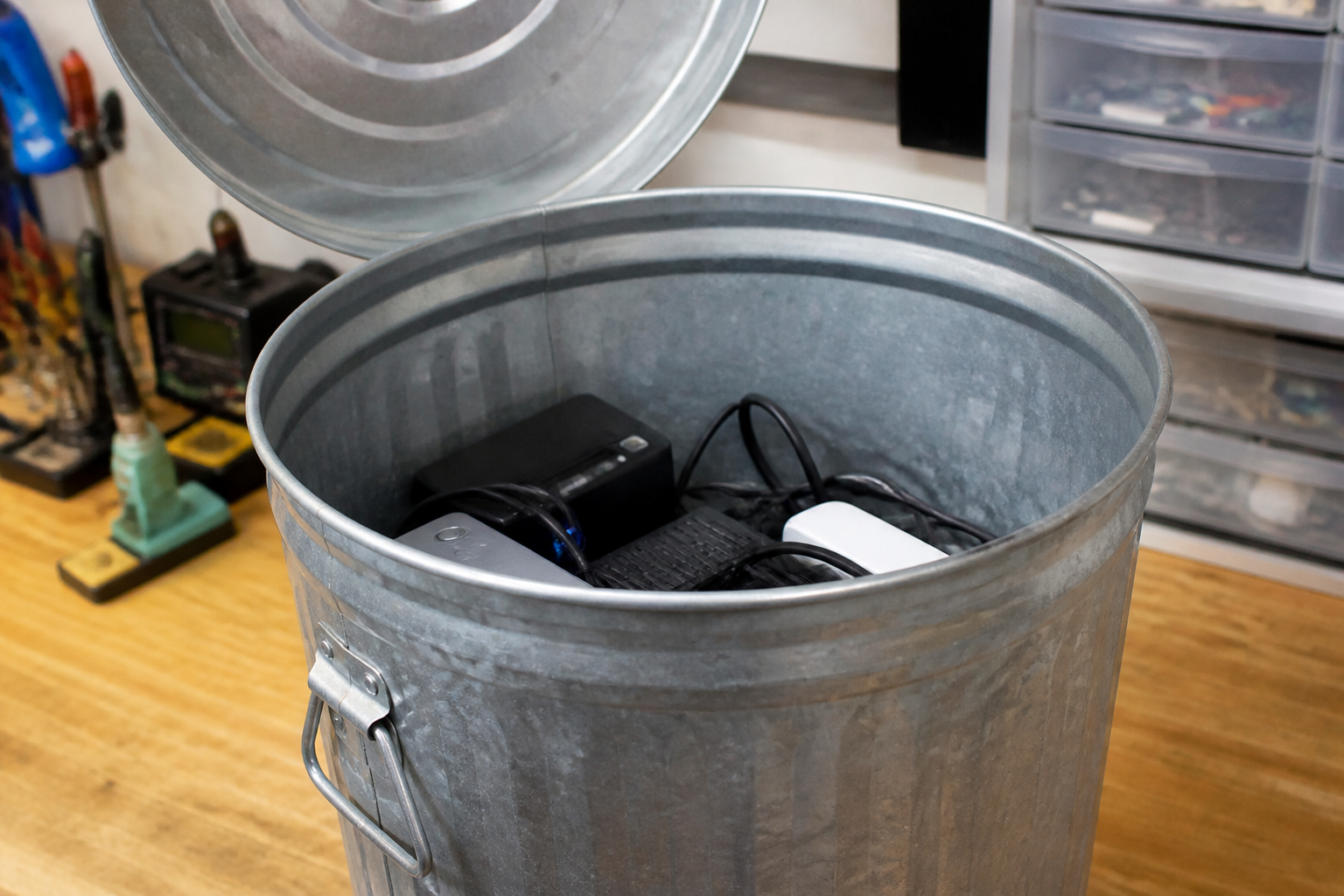
For home use, a galvanized steel trash can with a tight-fitting lid is one of the most practical and affordable options. A 20-gallon can costs roughly $30-50 at any hardware store. Line the inside with cardboard, foam, or a non-conductive material so your devices don't directly contact the metal, then layer a second lining of aluminum foil inside that. Seal the lid with copper or aluminum tape along the rim to close gaps. The result is a genuine, layered Faraday enclosure — not perfect, but genuinely functional for most threat models.
Ammo cans (properly sealed with conductive tape along the gasket) work for smaller items. Military-surplus equipment cases with metal bodies and tight latches are another solid option. For serious protection, dedicated EMP-shielding bags rated and tested to MIL-STD-461 provide a convenient portable option — though their effectiveness depends heavily on the quality of the seal.
What to store inside your Faraday cage matters as much as building the cage itself. Prioritize:
Whatever enclosure you use, test the seal with an AM/FM radio: turn it on, tune it to a station, place it inside, and close the lid. If you can still hear the station clearly, the cage has gaps that need addressing.
- A battery-powered or hand-crank emergency radio (NOAA/weather band capability)
- Spare charge controllers and inverters for any solar or battery system you have
- A power bank charged and disconnected from the grid
- Any critical medical electronics (hearing aids, spare blood glucose monitors)
- A basic shortwave or ham radio if you have one
- USB drives with critical data and document scans
- Spare ignition modules or a CDI unit if your vehicle uses solid-state ignition
Protecting the Electronics You Can't Put in a Box
Most of your home's electronics can't realistically be stored in a Faraday cage — your refrigerator, HVAC system, well pump, and vehicle are all in use. The practical goal is not to protect everything; it is to protect enough that you can function after a grid-down event.
For your vehicle, older carbureted vehicles with points-style ignition are far less vulnerable than modern vehicles with computer-controlled fuel injection and CAN-bus electronics. If you have a pre-1980s carbureted vehicle, keeping it maintained is itself a preparedness asset. For modern vehicles, there is no practical owner-level EMP hardening short of a garage built as a Faraday structure — which is outside most budgets.
For whole-home power systems — solar arrays, inverters, battery banks — the most practical approach is to keep one complete spare charge controller and a spare inverter inside your Faraday storage. You cannot protect a panel array from EMP, but a spare controller stored in a steel can means you can potentially restore function after an event once it is safe to work outside.
For the grid connection itself: nothing a homeowner can do will protect against a prolonged grid failure caused by transformer destruction. That is an infrastructure-level problem with a months-to-years recovery timeline in a worst-case scenario. Your goal is to have the stored equipment and knowledge to operate independently of the grid for as long as possible.
Our Recommendation: Grid Phantom
The core problem this article addresses is real and asymmetric: a single EMP event — natural or man-made — could render the electronics your household depends on permanently non-functional, with no warning and no second chance to prepare.
The honest gap in the DIY approach is knowledge, not materials. Steel trash cans and copper tape are cheap, but understanding which threat levels require which shielding standards, how to verify your protection is actually working, and how to structure a complete household EMP preparedness plan takes time and research that most people won't do from scratch — and bad information is everywhere in this space.
Grid Phantom is designed to address exactly that gap — providing a structured, actionable system for protecting your household electronics and power infrastructure against EMP and grid-down scenarios. Given that the product's detailed specifications and pricing are best confirmed directly at purchase, we recommend reviewing exactly what is included before buying. If EMP preparedness is a gap in your current power plan — and for most households, it is — Grid Phantom is worth a close look.
Our recommendation
Grid Phantom
Check availability →This article contains an affiliate link. If you buy through it, we may earn a commission at no extra cost to you.
Frequently asked questions
Does a Faraday cage actually protect against an EMP?
Yes, a properly constructed Faraday cage — made from conductive metal, sealed without gaps, and lined so devices don't touch the metal directly — provides real protection. Effectiveness varies with construction quality and the intensity of the pulse, but a steel enclosure with a sealed lid is dramatically more protective than an unshielded device.
Will a surge protector protect my electronics from an EMP?
No. Surge protectors react too slowly to respond to an EMP pulse, which rises in nanoseconds. The protector itself may be destroyed by the pulse before it can clamp the voltage. Do not rely on surge protectors for EMP protection.
What electronics should I prioritize putting in a Faraday cage?
Prioritize items that restore function after a grid-down event: a hand-crank or battery emergency radio, spare solar charge controllers, a charged and disconnected power bank, critical medical devices, and any ham or shortwave radio equipment. Protecting these gives you communication and the ability to restore a basic power system.
How likely is an EMP event to actually happen?
Geomagnetic storms from solar activity are well-documented and occur on a regular cycle — the 1989 Quebec blackout affected millions. A severe Carrington-level event is a recognized low-probability, high-consequence risk. High-altitude nuclear EMP is a national security concern addressed in government reports, but its real-world probability for any given household is impossible to quantify. The preparedness calculus is that the cost to protect a set of backup electronics is low, while the cost of losing all electronics in a grid-down scenario is very high.
Can a CME (solar flare) destroy personal electronics?
A severe CME primarily threatens large conductive infrastructure — power lines, transformers, and grid equipment — rather than small personal devices. However, devices plugged into the grid during a major CME can be damaged by the induced surge traveling through power lines. Unplugging sensitive electronics during a confirmed severe geomagnetic storm warning is a simple, free protective step. Standalone devices not connected to the grid or an antenna are at much lower risk from a CME than from a HEMP event.
Related guides
Sources
- NASA — Severe Space Weather Events: Understanding Societal and Economic Impacts
- FEMA — Emergency Planning for Electromagnetic Pulse (EMP)
- NOAA Space Weather Prediction Center — Geomagnetic Storms
- Congressional EMP Task Force — State of EMP Preparedness Report
General preparedness information, not medical or legal advice. Follow instructions from your local emergency authority during an active event.
Field notes by email
Get the next guide before you need it
One email when a new field guide drops — water, food, power, medicine. No spam, no daily noise, unsubscribe in one click.
Comments on this guide
Questions, corrections and field reports from your own setup are welcome.
No comments yet. Be the first to add a field report.