
Power
How to Protect Your Electronics from an EMP or Grid-Down Event (What Actually Works)

By Ephraim Rusk · · 10 min read
This article contains an affiliate link. If you buy through it, we may earn a commission at no extra cost to you.
Quick answer
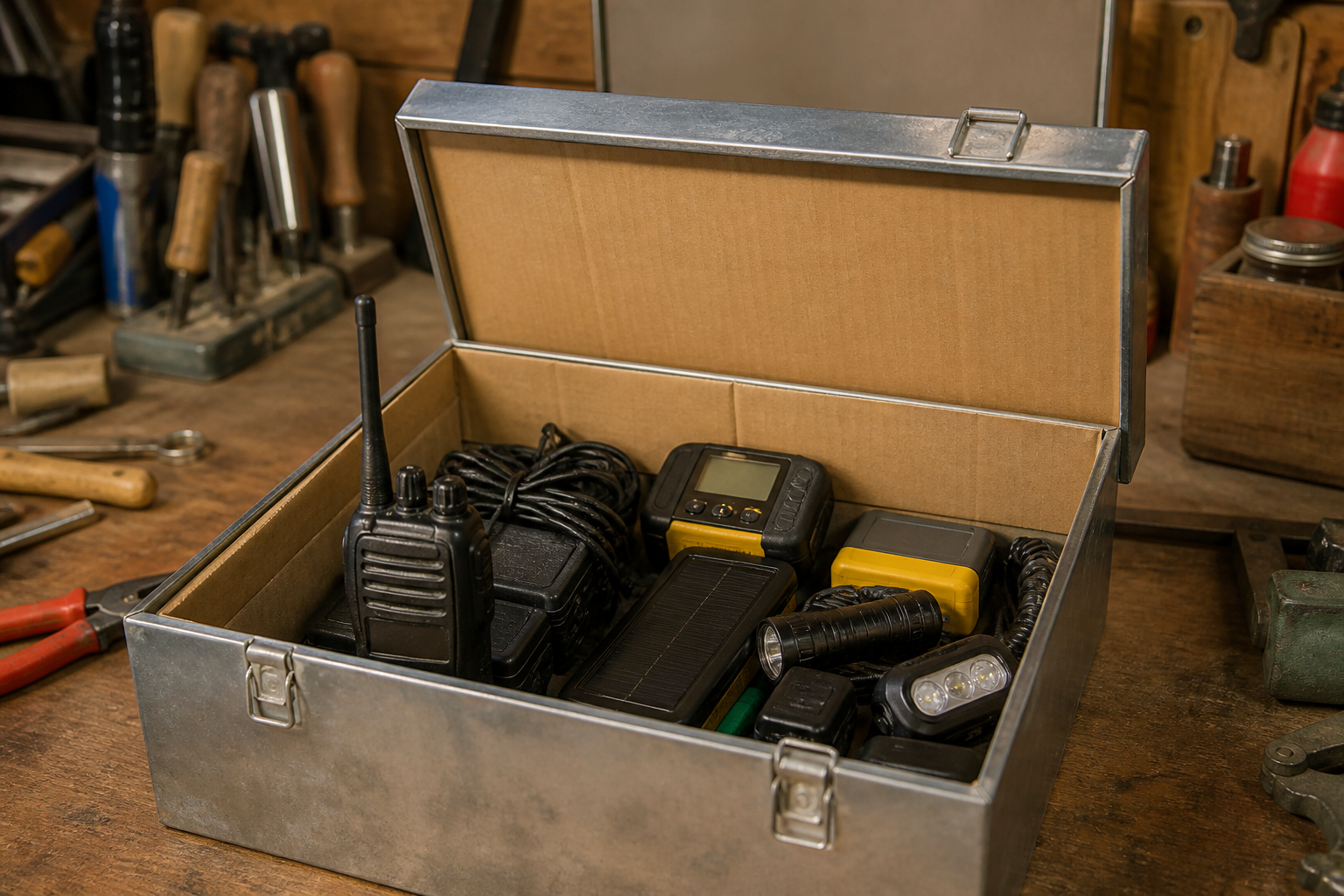
Store critical electronics in a grounded metal enclosure — commonly called a Faraday cage — lined with non-conductive insulation. Disconnect devices from the grid before a storm or known threat, because a connected device is far more vulnerable than an unplugged one.
EMP protection for home electronics is one of the most searched — and most misunderstood — topics in the preparedness space. Type 'how to protect electronics from EMP' into any search engine and you will get a mix of solid physics, survivalist mythology, and products that make promises nobody can fully verify. This article cuts through that noise.
A large-scale electromagnetic pulse event — whether from a nuclear detonation at altitude, a severe geomagnetic storm like a Carrington-class event, or a directed-energy weapon — has the potential to damage or destroy unprotected electronics across a wide area. The Department of Homeland Security and academic researchers have confirmed that modern infrastructure, which is far more dependent on microelectronics than it was in 1989 or 1859, carries real vulnerability. What remains genuinely uncertain is the precise damage radius and the threshold at which consumer devices fail.
What is not uncertain: a household that loses every device simultaneously — phones, inverters, radios, medical equipment, vehicle electronics — faces a categorically harder survival situation than one that preserved even a few working tools. This guide covers the real methods, their real limitations, and what a practical prepper household can do this weekend to meaningfully reduce that risk.
What an EMP Actually Does to Your Devices
An electromagnetic pulse damages electronics by inducing a sudden, massive voltage spike in any conductor it reaches — wires, circuit board traces, antenna leads, and even the metal cases of appliances. That spike overwhelms the tolerance of transistors and integrated circuits, the same components that run everything from your inverter to your vehicle's engine control module.
There are three recognized threat categories. An E1 pulse, the fastest component of a nuclear EMP, arrives in nanoseconds and targets small electronics directly. An E3 pulse, similar in character to a geomagnetic storm, is slower but induces damaging currents in long conductors like power lines and pipelines — which then back-feed into anything connected to the grid. A geomagnetic storm from a solar coronal mass ejection (CME) is primarily an E3-type threat: it is less likely to fry a battery-powered radio sitting on a shelf, but it can take down the grid for months if transformers are damaged.
The practical implication is that your biggest vulnerability is anything plugged into the wall. A device connected to utility power has a long antenna — hundreds of miles of wire — funneling induced current directly to its inputs. An unplugged, battery-powered device in a metal enclosure is dramatically better protected, though not immune to a very close or very strong E1 event.
Faraday Cages: What Works and What Doesn't
A Faraday cage is any continuous conductive enclosure that intercepts an incoming electromagnetic field and routes it around — not through — the space inside. The concept is sound physics; the execution is where most DIY attempts fall short.
A properly built Faraday cage requires full electrical continuity across every seam, joint, and lid. A metal trash can with a tight-fitting lid is a popular recommendation, and testing by amateur radio operators and some university labs suggests it provides meaningful attenuation — but 'meaningful' is not the same as 'complete.' Gaps at the lid, even small ones relative to the wavelength of the threat, reduce shielding effectiveness. A layer of non-conductive material (cardboard, foam, fabric) inside the cage prevents the stored devices from touching the cage wall and creating a conduction path.
Galvanized steel trash cans, ammo cans with good gaskets, and purpose-built Faraday bags all show real-world attenuation in RF testing. Military surplus ammo cans — if the gasket is intact and the lid seals flush — are among the most reliable off-the-shelf options. Stack multiple layers for critical items: a device inside a sealed bag, inside an ammo can, inside a larger metal cabinet, gives you defense in depth.
What does not work well: standard cardboard boxes wrapped in a single layer of aluminum foil, unsealed containers with visible gaps, and any enclosure with cables or antennas running through the wall without proper RF-filtered penetrations. The foil-wrapped box has become a meme in prepper circles, but independent RF attenuation tests routinely show it performs poorly compared to even a basic metal container with a tight lid.
- Galvanized steel trash can with a tight-fitting lid: effective for most E3 and moderate E1 scenarios when properly lined
- Military surplus ammo cans (30-cal or 50-cal): good gasket seal, well-tested, portable
- Purpose-built Faraday bags: convenient for everyday carry items like phones and small radios, variable quality — look for tested attenuation ratings
- Nested enclosures: best defense-in-depth approach for your most critical gear
- Single-layer foil wrapping with no sealed enclosure: inadequate, do not rely on it
Which Electronics Are Actually Worth Protecting
Prioritize devices that you cannot replace and that directly support survival functions — communication, water, food, and medical care.
A battery-powered AM/FM/shortwave/NOAA weather radio is the single highest-value item to protect. In a true grid-down scenario, radio is how you learn what happened, how long the outage will last, and where assistance is available. A handheld ham radio (even if you only use it to monitor) belongs in the same category. Protect one of each.
After communication: a small solar charge controller and a quality multimeter, because these let you assess and use whatever solar panels survived. Panels themselves are somewhat less vulnerable than electronics with microprocessors — they have no active components — but the charge controller and inverter are fragile. A spare inverter in a Faraday can is cheap insurance.
Medical devices rank highest for households that depend on them. Insulin pumps, CPAP machines, powered hearing aids, and powered wheelchairs are not optional. If any family member relies on powered medical equipment, protecting a backup unit or its electronic control board should be the first priority — before radios, before anything else.
Lower priority for Faraday protection: large appliances (refrigerator, washer), desktop computers (high replacement value but not immediately survival-critical), and entertainment electronics. Protect what keeps you informed, connected, and medically stable first.
Practical Steps You Can Take This Weekend
You do not need to spend thousands of dollars or build a shielded room to meaningfully improve your EMP resilience. A few targeted actions this weekend move the needle more than years of planning with no follow-through.
First, buy one galvanized steel trash can (20-gallon is a practical size) and line it with cardboard or foam. Place inside it: one weather/shortwave radio with fresh batteries, a handheld radio if you own one, a spare solar charge controller if you have solar, and a basic written emergency contact and frequency list — because a working radio is useless if you cannot remember which frequencies to monitor.
Second, inventory every device your household depends on that has a microprocessor. Write it down. Decide which items cannot be replaced in a year-long grid-down scenario, and protect those first.
Third, unplug non-essential electronics during severe geomagnetic storm warnings. NOAA's Space Weather Prediction Center issues G-scale geomagnetic storm alerts (G3 and above warrant real attention). Signing up for free email or text alerts from NOAA costs nothing and gives you advance warning for CME-type events, which typically have a travel time of one to three days from the sun.
Fourth, keep vehicles with older, simpler engine management systems — or pre-1980 vehicles with no electronic ignition — in better mechanical condition than newer vehicles. Older vehicles have significantly fewer vulnerable electronic components. This is not a reason to get rid of a modern vehicle; it is a reason to keep an older one if you already have it.
- Buy a galvanized steel trash can and line it — do this this weekend, not someday
- Stock it with a weather radio, spare batteries, emergency frequency and contact list
- Sign up for free NOAA Space Weather alerts at swpc.noaa.gov
- Identify and prioritize any powered medical devices in your household
- Keep at least one backup charge controller and inverter in a sealed metal container if you rely on solar
Our Recommendation: Grid Phantom
The core problem this article lays out is straightforward: in an EMP or extended grid-down event, unprotected electronics fail, and most households have no fallback. Communication, water pumping, medical devices, and basic situational awareness all depend on electronics that most people have done nothing to protect.
The honest limitation of the DIY approach is information, not materials. Metal cans and foam are cheap. What costs people is not knowing which specific devices to prioritize, how to test whether a shielding method actually works, and how to build a layered power strategy that holds up when the grid does not come back in 72 hours. Searching through conflicting blog posts and YouTube channels to piece that picture together takes time most people never find.
Grid Phantom is built around exactly that gap — providing a structured framework for EMP and grid-down power protection so you are not starting from scratch when a threat is already developing. If you have read this far and realize your household has no protected electronics and no grid-down power plan, Grid Phantom is the logical next step. Take a look and see if the approach fits your situation. For the next step, read How to Reduce Your Electric Bill with a DIY Backup Power Setup (Without a Full Solar Install).
Our recommendation
Grid Phantom
Check availability →This article contains an affiliate link. If you buy through it, we may earn a commission at no extra cost to you.
Frequently asked questions
Does a microwave oven work as a Faraday cage for EMP protection?
A microwave oven has conductive shielding designed to keep microwaves in, not to keep all electromagnetic frequencies out. Some informal tests show partial attenuation for certain frequencies, but it is not designed or rated as EMP shielding. A purpose-built Faraday enclosure with a sealed lid is more reliable.
Will an EMP destroy a car that is turned off and parked?
Modern vehicles with electronic ignition and engine control modules carry some vulnerability, but the actual damage threshold depends heavily on pulse intensity and distance. Vehicles parked away from long stretches of connected wiring may survive moderate events. Pre-1980 vehicles with no electronic ignition are generally considered more resilient.
How much warning will we get before an EMP or geomagnetic storm?
For a solar CME-type geomagnetic storm, NOAA's Space Weather Prediction Center can provide one to three days of advance notice after a coronal mass ejection is observed. A nuclear EMP provides no warning. This is why passive protection — a Faraday cache already built — matters more than reactive preparation.
Do solar panels survive an EMP?
Solar panels have no active electronics and are generally considered more resistant to EMP than inverters and charge controllers. However, the controller and inverter connected to the panels are vulnerable. Keeping a spare charge controller in a Faraday enclosure is a practical and inexpensive backup measure.
Is EMP protection actually necessary, or is this prepper overreaction?
The threat is real enough to have prompted official U.S. government reports, including the 2019 Executive Order on Coordinating National Resilience to Electromagnetic Pulses. The probability of a large-scale event is genuinely uncertain, but the cost of basic protection is low — a steel can and a weather radio — which makes it a reasonable low-effort preparation for most households.
Related guides
Sources
- FEMA: Electromagnetic Pulse (EMP) and Geomagnetic Disturbance Planning
- NOAA Space Weather Prediction Center: Geomagnetic Storm Alerts
- DHS CISA: Electromagnetic Pulse Resilience
General preparedness information, not medical or legal advice. Follow instructions from your local emergency authority during an active event.
Field notes by email
Get the next guide before you need it
One email when a new field guide drops — water, food, power, medicine. No spam, no daily noise, unsubscribe in one click.
Comments on this guide
Questions, corrections and field reports from your own setup are welcome.
No comments yet. Be the first to add a field report.