
Power
How to Protect Your Electronics from an EMP or Grid-Down Event (What Actually Works)

By Ephraim Rusk · · 11 min read
This article contains an affiliate link. If you buy through it, we may earn a commission at no extra cost to you.
Quick answer
The most reliable way to protect electronics from an EMP is to store them unplugged inside a properly constructed Faraday enclosure — a conductive, grounded metal container with no gaps — before an event occurs. Surge protectors and standard power strips offer no meaningful protection against a true EMP pulse.
Protecting electronics from an EMP, or electromagnetic pulse, is one of the most misunderstood topics in preparedness. Search online for five minutes and you will find everything from aluminum foil wraps to elaborate grounding rigs — and almost no consensus on what actually works. Meanwhile, the stakes are real: the Congressional EMP Commission has documented that a significant high-altitude EMP event could damage or destroy solid-state electronics across a wide geographic area, and a severe geomagnetic storm from a Carrington-class solar event would cause similar effects on grid-connected equipment.
Most prepper households have invested hundreds or thousands of dollars in radios, medical devices, power banks, communication tools, and backup electronics that would become paperweights overnight if an EMP struck and nothing was done to protect them. The frustrating part is that many of the most popular DIY solutions — cheap Faraday bags, ungrounded metal boxes, or surge protectors — are either unverified, poorly executed, or simply wrong for the threat. This article breaks down what the science and established guidance actually say, what protection methods are worth your time, and where the realistic limits of each approach lie.
This is not a doomsday piece. The probability of any individual household experiencing an EMP event on a given day is low. But EMP protection is one of the few preparedness investments that costs relatively little, takes almost no ongoing maintenance, and is completely irreversible in value: if you need it and have it, your electronics work; if you need it and do not have it, they almost certainly do not.
What an EMP Actually Does to Your Electronics
An electromagnetic pulse damages electronics by inducing sudden, massive voltage spikes in any conductive material — wiring, circuit boards, antennas, power lines — faster than any surge protector or fuse can respond. The result is not a gradual degradation; it is instantaneous failure of transistors, microcontrollers, and semiconductors that make modern electronics function.
There are three distinct EMP threat sources worth understanding, because the protection strategy overlaps but is not identical for each. First, a nuclear high-altitude EMP (HEMP), detonated above the atmosphere, produces three waveform components: E1, a near-instantaneous spike measured in nanoseconds that destroys solid-state electronics; E2, similar to a lightning strike; and E3, a slow pulse similar to a geomagnetic storm that attacks long conductors like power lines and pipelines. Second, a geomagnetic storm caused by a coronal mass ejection from the sun — the Carrington Event of 1859 is the historical benchmark — produces primarily E3-type effects at scale, threatening grid infrastructure and anything connected to it. Third, non-nuclear EMP devices (directed-energy weapons) exist but are currently limited in range and are a lower-probability civilian concern.
The practical takeaway is that E1 is the component that destroys the electronics sitting on your shelf or in your bag. E3 is what collapses the grid. Your Faraday protection strategy is primarily aimed at E1 — shielding devices from the fast spike. Getting those devices off the grid before E3 does its work on infrastructure is a separate, related concern.
It is worth being direct about uncertainty here: independent, reproducible, publicly available testing on which consumer-grade Faraday products actually stop E1-level fields is limited. The U.S. military has EMP hardening standards (MIL-STD-461, for example), but consumer products are not tested to those standards. What we do have is well-established physics: a continuous conductive enclosure with no gaps, properly bonded, attenuates electromagnetic fields. The engineering principles are sound even where specific product testing data is thin.
Faraday Cages: The Science Behind the Only Reliable Shielding Method
A Faraday cage works by distributing an external electromagnetic field across its conductive surface, canceling the field inside the enclosure — but only if the cage is properly constructed. This is not theoretical; it is demonstrable physics described by Michael Faraday in 1836 and confirmed in countless engineering applications since.
For a Faraday enclosure to provide meaningful EMP protection, it needs to meet several criteria. The enclosure must be made of a conductive metal — steel, copper, and aluminum all work, with steel providing better attenuation for the low-frequency E3 component. There must be no gaps or apertures larger than roughly one-tenth of the wavelength of the field you are trying to block; for E1 frequencies, that means gaps need to be very small — seams must be bonded, not just touching. The enclosure itself should not have conductive wires running through it, since those act as antennas and defeat the purpose. And the items inside must not be touching the walls of the enclosure.
Common mistakes that reduce or eliminate Faraday cage effectiveness include: using a metal trash can with a loose-fitting lid (the lid-to-can gap is a significant aperture); placing electronics directly against the metal walls; running a power cord through the lid to keep a device charging inside the cage; and relying on a single thin layer of aluminum foil without an inner insulating layer to prevent contact with the conductive surface.
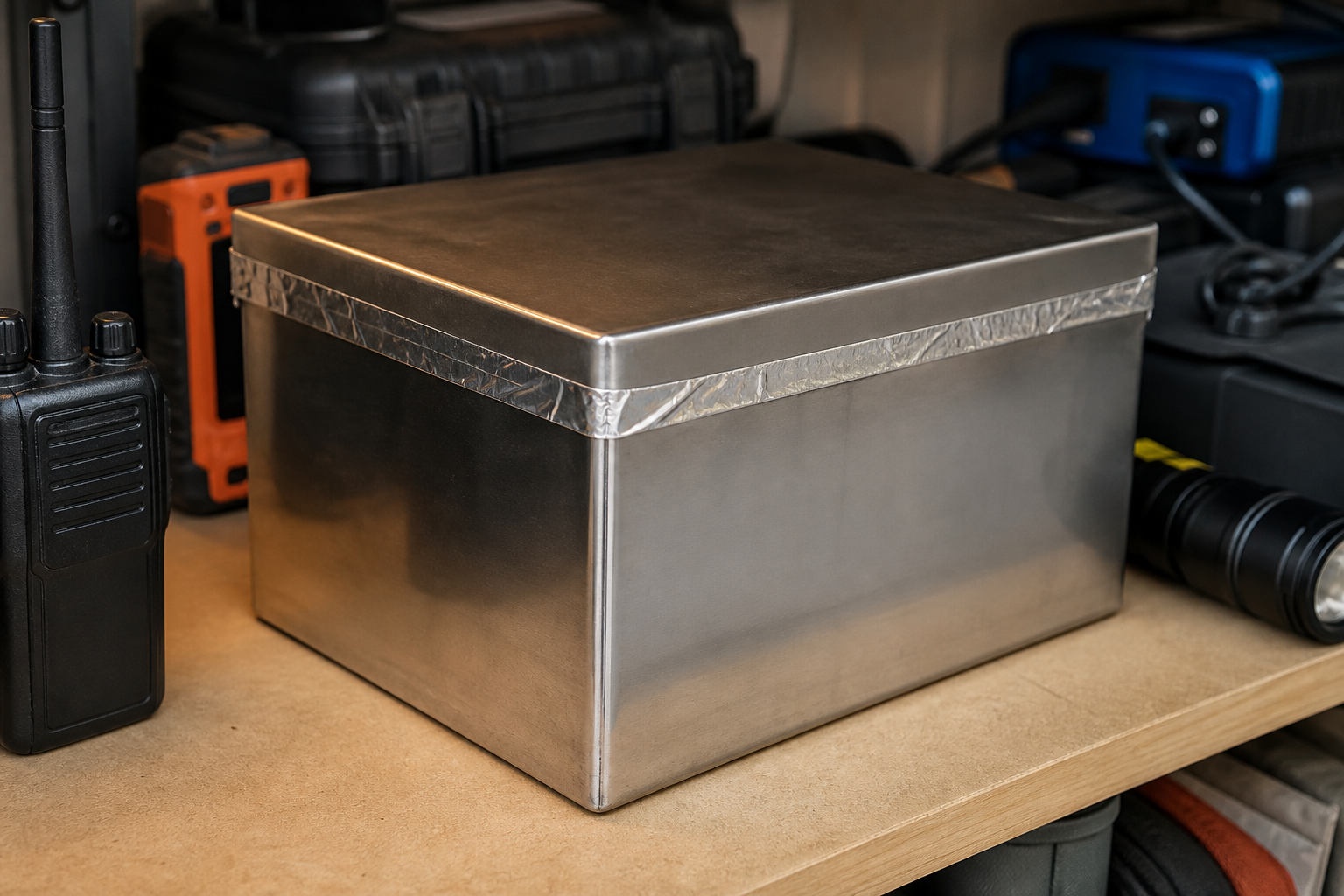
A functional DIY Faraday enclosure can be built: a steel ammo can with conductive tape sealing the lid gasket, an inner layer of cardboard or foam to prevent direct contact with the metal, and no penetrations. Galvanized steel trash cans with lids taped shut using copper tape around the entire perimeter are a common and reasonably effective approach if done carefully. The key word is carefully — gaps kill effectiveness, and most casual builds have gaps.
- Use steel, copper, or aluminum — not plastic or wood
- Seal every seam and the lid perimeter with conductive tape
- Line the inside with a non-conductive layer (cardboard, foam, rubber) before placing electronics
- Do not run any wires through the enclosure
- Do not let stored devices touch the metal walls
- Store enclosures away from large antennas or external wiring that could couple energy into the cage
What Does NOT Protect Your Electronics (Common Misconceptions)
Surge protectors, UPS units, and standard power strips provide zero protection against a true EMP pulse. This is the single most important correction in this entire article. A surge protector is designed to clamp slow-rise voltage spikes from lightning or grid fluctuations — events measured in microseconds to milliseconds. An E1 EMP rise time is measured in nanoseconds, roughly 1,000 times faster than what surge protection circuitry can respond to. The protector itself becomes a liability because it is plugged into the grid, which acts as a massive antenna.
Disconnecting devices from the grid is useful — an unplugged device is less exposed than a grid-connected one, because it is not coupled to the long-conductor antenna effect of household wiring. But 'unplugged' alone does not protect against E1 radiation traveling through the air to reach solid-state components. The device needs to be inside a shielded enclosure.
Single-layer aluminum foil is widely cited as a Faraday solution and is partially right in theory, but almost always inadequate in practice. Foil tears easily, creating gaps. A single layer provides limited attenuation. And if the foil layer is the only barrier between the electronics and the conductive surface, arcing or contact can damage the very devices you are protecting. If you use foil at all, use multiple tight layers with an insulating layer between the foil and the device.
Cloud backups protect your data, not your devices. After an EMP event, with the grid down, the cloud is not accessible. Backing up data is a sound general practice but is not an EMP protection strategy for functional hardware.
Grounding a Faraday cage is a point of ongoing debate among engineers. Proper bonding of the cage itself matters; whether a ground connection to earth improves or worsens consumer-level EMP protection for stored devices is genuinely contested. The safe default from most independent guidance is to focus on the quality of the enclosure seal rather than relying on a ground connection to compensate for gaps.
Prioritizing What to Protect: A Practical Triage for Prepper Households
You cannot Faraday-cage your entire house, and you should not try to. The practical approach is to identify which electronics are irreplaceable and critical to post-event function, store those inside a quality enclosure, and accept that everything else is at risk.
The highest-priority items for EMP protection are: a backup handheld HAM radio or shortwave receiver (grid-down communications depend on it), a battery-powered or hand-crank emergency radio, spare solar charge controllers (the grid-tied inverter in your main solar system will likely be damaged, but a spare charge controller inside a Faraday cage preserves the ability to charge batteries post-event), medical devices that cannot be replaced (hearing aids, blood glucose monitors), and a secondary phone or tablet loaded with offline maps, medical references, and critical documents.
Secondary priority items include: extra LED flashlights and headlamps, spare batteries and quality battery banks, ignition components for older vehicles if you depend on them (pre-1980s vehicles with points-based ignition are more resilient; modern vehicles with electronic fuel injection and engine control units are significantly more vulnerable), and a backup set of hand tools if your primary tools are electronic.
Items that are expensive but relatively low priority for Faraday storage: large appliances, wall-mounted solar inverters (protect the controller, not the panels — panels themselves are generally more resilient), desktop computers (useful post-event but not immediately critical compared to communications and medical equipment).
A useful rule of thumb from emergency management guidance: store what you cannot replace and cannot do without for 30 days. If you can live without it or improvise around it, prioritize the cage space for something else.
- Handheld HAM or shortwave radio — highest priority
- Spare solar charge controller
- Battery banks and quality rechargeable batteries
- Medical devices (hearing aids, glucose monitors, CPAP controller)
- Emergency radio (hand-crank or battery)
- Offline-loaded secondary phone or tablet
- Spare vehicle ignition components if applicable
Our Recommendation: Grid Phantom
Here is the core problem this article keeps returning to: knowing EMP protection principles and actually executing a reliable, gap-free shielding solution are two different things. Gaps in a Faraday enclosure are not always visible to the naked eye, and the difference between a well-built enclosure and a poorly built one is the difference between working electronics and expensive scrap after an event.
The DIY path is viable, but it requires sourcing the right materials, correctly sealing every seam, testing the enclosure (which requires RF measurement equipment most households do not own), and staying current as your stored device inventory changes. Most households that start with a DIY build either under-build it or never test it — and you will not get a second chance to find out which category you fall into.
Grid Phantom is designed for exactly this gap between knowing and doing — providing EMP and grid-down protection guidance and solutions for households that want reliable protection without building it from scratch under uncertainty. If you have been putting off a real EMP protection plan because the DIY path felt too technically uncertain, Grid Phantom is worth a serious look as a structured starting point. Take a look at Grid Phantom and decide whether it fills the gap in your current power preparedness plan. For the next step, read DIY Off-Grid Power Systems for Beginners: What You Actually Need Before You Build.
Our recommendation
Grid Phantom
Check availability →This article contains an affiliate link. If you buy through it, we may earn a commission at no extra cost to you.
Frequently asked questions
Does a Faraday cage actually protect against EMP?
Yes, a properly constructed Faraday cage attenuates electromagnetic fields inside the enclosure based on well-established physics. The critical word is 'properly' — the enclosure must be continuous conductive metal with no gaps, bonded seams, and no wires running through it. Loose-fitting lids, taped foil with tears, or metal containers with unsealed seams significantly reduce or eliminate protection.
Will unplugging my electronics protect them from an EMP?
Unplugging removes the antenna effect of household wiring, which helps with E3-type grid-coupled damage. But unplugging alone does not protect solid-state electronics from E1 radiation traveling through the air. For meaningful EMP protection, devices need to be inside a shielded enclosure, not just unplugged.
Can a metal trash can work as a Faraday cage for EMP protection?
A galvanized steel trash can can work as a basic Faraday enclosure if the lid is sealed around its entire perimeter with conductive tape, the interior is lined with a non-conductive material to prevent devices from touching the metal walls, and no wires penetrate the enclosure. An unsealed or loose-fitting lid with gaps significantly reduces effectiveness.
What electronics are most vulnerable to an EMP?
Modern solid-state electronics with transistors, microcontrollers, and integrated circuits are most vulnerable — smartphones, laptops, inverters, charge controllers, and modern vehicle engine control units. Older analog electronics and simple mechanical devices are far more resilient. The longer and more complex the internal circuitry, the more vulnerable the device.
How likely is an EMP event that would actually damage home electronics?
A nuclear high-altitude EMP is a low-probability, high-consequence event — it requires a deliberate hostile act. A severe geomagnetic storm (Carrington-class) is considered a credible natural hazard; researchers estimate a roughly 1-in-8 chance of a major geomagnetic storm occurring this century, though the probability of it being severe enough to damage well-constructed home electronics is lower and genuinely uncertain. EMP protection is most valuable as a low-cost hedge against a high-impact, irreversible outcome.
Related guides
Sources
- FEMA — Planning for an Electromagnetic Pulse Event
- Oak Ridge National Laboratory — Electromagnetic Pulse: Effects on the U.S. Power Grid (DOE)
- NOAA Space Weather Prediction Center — Geomagnetic Storms
General preparedness information, not medical or legal advice. Follow instructions from your local emergency authority during an active event.
Field notes by email
Get the next guide before you need it
One email when a new field guide drops — water, food, power, medicine. No spam, no daily noise, unsubscribe in one click.
Comments on this guide
Questions, corrections and field reports from your own setup are welcome.
No comments yet. Be the first to add a field report.