
Security
Kubotan vs Tactical Pen: Which Is Actually Better for Self-Defense?

By Ephraim Rusk · · 10 min read
This article contains an affiliate link. If you buy through it, we may earn a commission at no extra cost to you.
Quick answer
A kubotan and a tactical pen serve the same palm-stick function in close-quarters defense, but a tactical pen doubles as a legal writing instrument, making it easier to carry in restricted environments. The better choice depends on your legal situation and how much dedicated training you're willing to put in — either tool is only effective with practiced technique.
Kubotan vs tactical pen is one of the most common debates in everyday-carry self-defense circles, and for good reason: both are small, legal in most jurisdictions, and built around the same palm-stick concept. If you're trying to decide which one belongs in your preparedness kit, the surface-level comparison — size, material, price — isn't actually where the decision lives.
The real question is what you're carrying it into, how you plan to use it, and whether you've put in the work to make either tool functional under stress. A kubotan sitting in a junk drawer and a tactical pen clipped to a shirt pocket are equally useless without technique. This article breaks down the genuine differences so you can make an informed choice — and tells you exactly what training that choice demands.
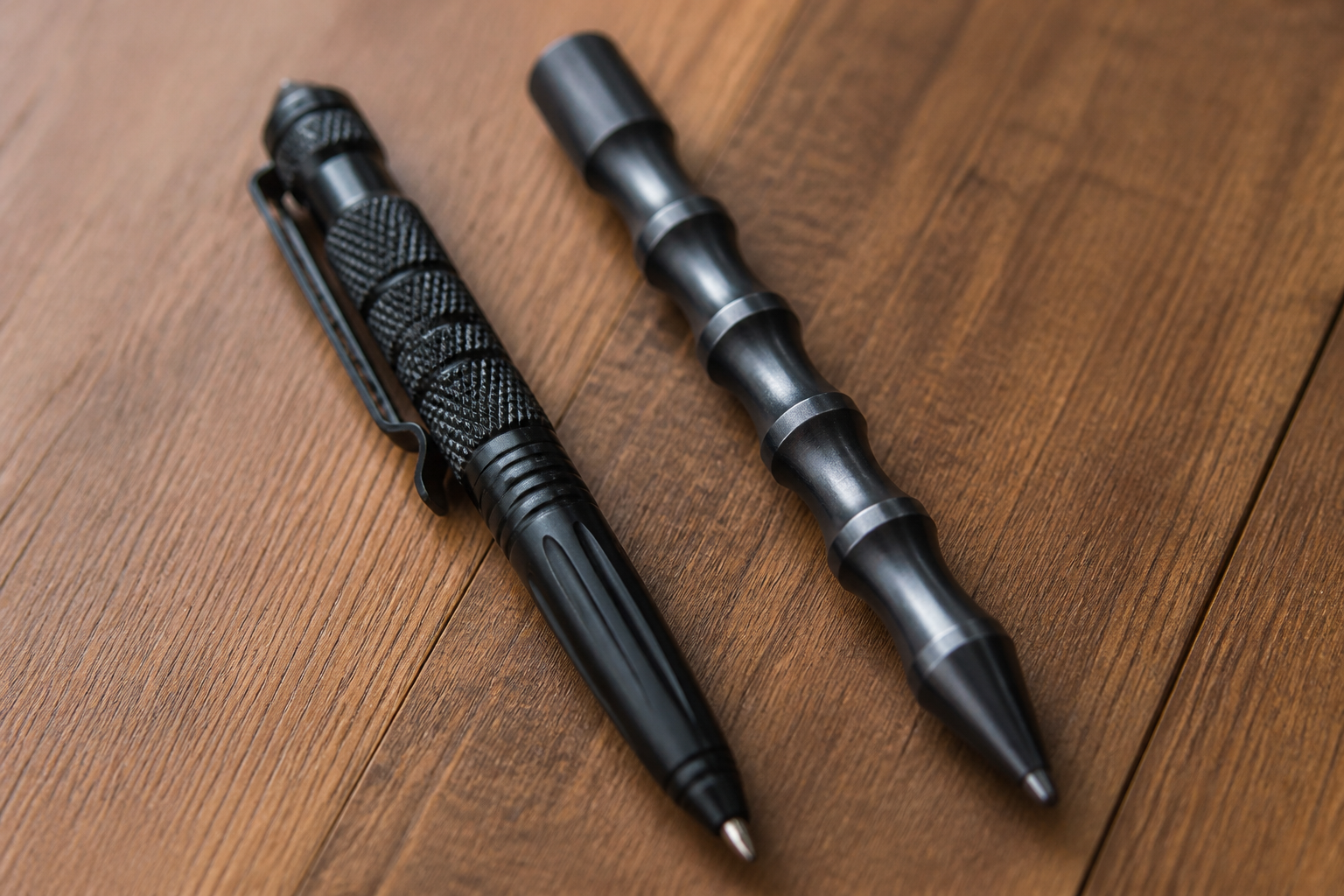
What Is a Kubotan and What Is a Tactical Pen (They're Closer Than You Think)
A kubotan is a short, cylindrical rod — typically 5 to 6 inches long and half an inch in diameter — originally developed by Sōke Takayuki Kubota in the 1970s for police use. It's made from hard polymer or aluminum, has no sharp edges by design, and is gripped in the fist with the ends protruding. The weapon creates what's called a 'palm stick': a rigid extension that concentrates force from a strike or pain-compliance pressure point technique into a very small surface area.
A tactical pen is a fully functional ballpoint pen reinforced with aircraft-grade aluminum or titanium, built to withstand the same grip and strike applications as a kubotan. The writing tip retracts or caps off, the body is machined to similar dimensions, and the rear is often flat or slightly pointed. In terms of what your hand does with it, the mechanics are nearly identical to palm-stick use.
The conceptual overlap is intentional. Manufacturers of tactical pens have explicitly borrowed from the kubotan tradition. Where they diverge is in profile, legal ambiguity, and — in some designs — the addition of features like glass breakers, fire starters, or stylus tips. For the purpose of self-defense mechanics, you're working with the same fundamental tool.
Where They Actually Differ: Grip, Carry, and Legal Profile
The most practical difference between a kubotan and a tactical pen is the legal and social context in which you can carry each one. A kubotan is unambiguously a self-defense tool — it has no secondary function. In jurisdictions that restrict or prohibit 'kubotans' by name (California, for example, has historically restricted them under certain circumstances, and several countries ban them outright), carrying one openly creates legal exposure. A tactical pen, by contrast, writes. In most airports, courthouses, and international travel scenarios, a pen is a pen until it isn't.
Grip differences are real but often overstated. A dedicated kubotan may have grooves or ridges for indexing under stress — useful when fine motor skills degrade in a fight. Some tactical pens have similar texturing; many don't. If your pen has a clip, that clip affects your grip and can cause the tool to rotate in your hand mid-strike — a detail that sounds minor until you're depending on it. Neither tool stays in hand reliably without training in retention.
Weight and balance also shift depending on construction. A heavy titanium tactical pen (some run 2 to 3 ounces) behaves differently than a lightweight polymer kubotan. Heavier tools can add impact force in strikes, but they also fatigue a grip faster in sustained clinch work. For most beginners, this distinction is secondary to technique — but it's worth knowing before you spend $80 on a machined pen and assume the price tag confers capability.
- Kubotan: purpose-built, no legal cover in restricted areas, excellent for dedicated palm-stick grip
- Tactical pen: functions as a real pen, easier to carry legally, clip can interfere with grip unless accounted for in training
- Both: same core striking and pressure-point mechanics, both require the same foundational technique to be effective
- Both: size and weight vary significantly by brand — standardize on one before building muscle memory
What Palm-Stick Technique Actually Looks Like in a Close-Quarters Situation
Palm-stick defense is a close-quarters system, which means it begins at the range where most people have already run out of good options — grab distance, inside a vehicle, pinned in a stairwell. The tool doesn't extend your reach or let you engage from distance. What it does is amplify the mechanical effect of moves you can already make with your hand: hammer strikes to soft tissue, pressure applied to nerve clusters at the wrist or neck, and control holds that are difficult to sustain bare-handed against someone significantly larger.
The strikes themselves follow gross motor patterns — downward hammer fist, inward forearm strike — which is deliberate. Under adrenaline, fine motor coordination collapses. Palm-stick systems are designed to use movements your body will still perform when your hands are shaking. The tool doesn't require precision; it requires practiced repetition so the gross movement becomes automatic.
Pressure-point applications are more nuanced and degrade faster under stress than strikes do. Techniques targeting the radial nerve at the wrist or the mastoid process behind the ear can create immediate, intense pain compliance against a cooperative or minimally resistant attacker. Against a determined, adrenaline-flooded, or chemically impaired attacker, those same techniques may produce little or no effect. This is not a failure of the tool — it's the honest reality of all pain-compliance systems, and any credible course will tell you so.
The common beginner error is treating the kubotan or tactical pen as a force multiplier that compensates for a lack of hand-to-hand fundamentals. It doesn't. The tool amplifies what you already have. Someone with basic striking mechanics and a kubotan is more dangerous than someone with no mechanics and the same kubotan.
Who Should Choose a Kubotan, Who Should Choose a Tactical Pen
Choose a kubotan if you live in a jurisdiction where it's legal to carry openly, you work or travel in environments without strict item screenings, and you want a dedicated tool optimized purely for the grip and strike applications you'll train. The purpose-built shape means no design compromises — the tool does one thing and is machined entirely around doing that one thing well.
Choose a tactical pen if your daily carry takes you through airports, government buildings, schools, or international travel where a kubotan would create legal or professional problems. A quality tactical pen carried legally and used after training is substantially better than a kubotan left at home to avoid a confrontation at a security checkpoint. The writing function is genuine cover, not a fiction.
A third group — people who carry a tactical pen primarily because they like the EDC aesthetic — should consider this honestly: if you haven't done structured palm-stick training, the pen is a writing instrument, not a self-defense tool. The gap between owning one and being able to use one under stress is real and requires deliberate work to close. The good news is that the work isn't extensive — focused study of the core techniques, practiced repeatedly, builds functional capability within a reasonable training window.
Our Recommendation: Hammer Concept Palm Stick Defense
Whether you settle on a kubotan or a tactical pen, you are holding a hard piece of metal or polymer with no inherent defensive value until you've built the technique to use it. That is the central problem this article has described: the tool is the easy part, available for under $30 almost anywhere. The technique is what most people never acquire.
The gap in most free or low-cost alternatives — YouTube clips, forum threads, the occasional self-defense class that covers kubotans for twenty minutes — is systematic progression. Isolated techniques don't hold up under stress the way a built sequence does. You need to understand the why behind each grip, each strike angle, and each transition before the movement becomes automatic, and scattered free content rarely provides that structure. It also rarely addresses the specific reality of defending against a stronger or armed attacker at close range, which is precisely the scenario this tool is designed for.
The Hammer Concept Palm Stick Defense course was built for that gap. It's a 26-lesson video course running over three hours, focused specifically on palm-stick and kubotan technique for beginners in close-quarters scenarios — including situations where escape isn't possible and the attacker is larger or armed. At €97 with a 60-day money-back guarantee, it gives you a structured, repeatable training resource you can work through at home before the moment you'd need it. If you've decided the tool belongs in your kit, this is where you build the capability to back that decision up.
Our recommendation
Hammer Concept Palm Stick Defense
Check availability →This article contains an affiliate link. If you buy through it, we may earn a commission at no extra cost to you.
Frequently asked questions
Is a kubotan legal to carry in the US?
Legality varies by state and municipality. Kubotans are generally legal to carry in most US states, but California has restricted them in certain contexts, and some cities have their own ordinances. Always verify local law before carrying any self-defense tool. A tactical pen, because it functions as a writing instrument, typically faces fewer restrictions — but 'tactical' branding can draw scrutiny. When in doubt, check your state's specific statutes on impact weapons or 'bludgeons.'
Can a kubotan or tactical pen stop a larger attacker?
It can create an advantage, but there are no guarantees with any self-defense tool. Palm-stick techniques are designed to amplify strikes and apply pain compliance against nerve clusters, which can create opportunities to escape or gain control. Against a significantly larger attacker — especially one under adrenaline or chemical influence — pain compliance techniques are less reliable. Strikes to vulnerable areas (throat, temple, mastoid) using a palm stick can be effective regardless of size difference, but require practiced technique to land accurately under stress.
What is the best way to hold a kubotan?
The standard grip is a closed fist with the kubotan seated in the palm, one end protruding from the pinky side for hammer strikes and the other from the thumb side for reverse strikes and pressure-point work. The tool should be seated deep in the fist — not held loosely — so it doesn't rotate on impact. Some instructors prefer a forward grip with the tip protruding from the thumb side for jabbing applications. Build one grip consistently before adding variations.
Can I bring a tactical pen on a plane?
TSA does not explicitly list tactical pens as prohibited items, and many people carry them through security without issue because they function as real pens. However, TSA agents have discretion to confiscate any item they judge to be a weapon, and 'tactical' labeling increases that risk. Carry a pen that writes and looks like a pen — understated designs pass more reliably than ones marketed aggressively as weapons. International regulations vary significantly, so research your destination country's rules before traveling.
How long does it take to learn basic kubotan techniques?
Basic palm-stick striking mechanics — the hammer strike, the ice-pick grip strike, and simple wrist control — can be learned and made functional with focused, consistent practice over several weeks. The limiting factor is not complexity but repetition: the techniques need to be practiced until they're automatic, because fine motor skill degrades sharply under stress. A structured course of 3 or more hours of instruction, practiced regularly, is a realistic path to beginner-level functional competence.
Related guides
Sources
- CDC: Violence Prevention — Understanding the Problem
- Bureau of Justice Statistics: Violent Crime Against the Person
- FEMA: Personal Safety and Self-Preparedness
General preparedness information, not medical or legal advice. Follow instructions from your local emergency authority during an active event.
Field notes by email
Get the next guide before you need it
One email when a new field guide drops — water, food, power, medicine. No spam, no daily noise, unsubscribe in one click.
Comments on this guide
Questions, corrections and field reports from your own setup are welcome.
No comments yet. Be the first to add a field report.